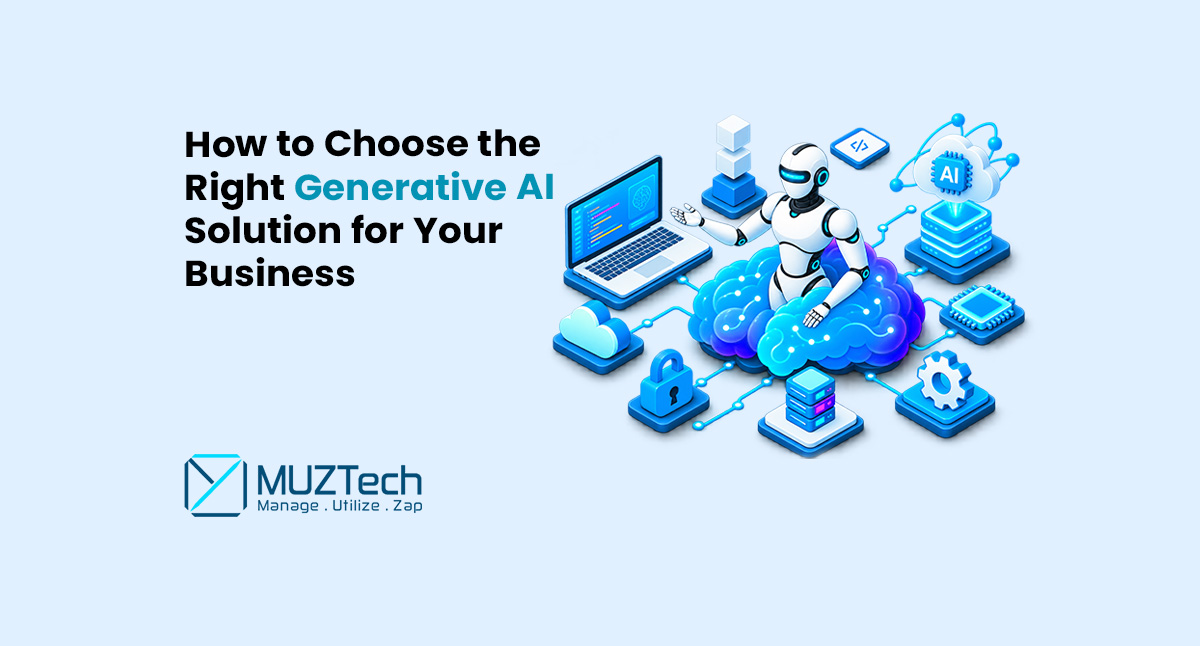
How to Choose the Right Generative AI Solution for Your Business
Generative AI is moving from experimentation into everyday business operations. Organizations are using it to improve customer service, analyze documents, support employees, accelerate software development, automate repetitive workflows, and build new digital products.
However, successful generative AI solutions are not created simply by selecting the newest AI model and connecting it to a website or application.
A reliable business AI system requires much more. Organizations need to understand the problem they are trying to solve, the data available to them, the appropriate AI architecture, security requirements, operating costs, evaluation methods, regulatory obligations, and the level of human oversight required.
The technology landscape has also become more complex. Businesses can now choose between large language models, Small Language Models, Retrieval-Augmented Generation, fine-tuning, long-context approaches, AI agents, multi-agent systems, and multi-model architectures.
The challenge is no longer simply adopting AI. The challenge is choosing and implementing the right AI approach for a specific business requirement.
This guide explains how businesses can evaluate, build, secure, measure, and scale generative AI solutions in 2026.
What Are Generative AI Solutions?
Generative AI solutions are applications and systems that use artificial intelligence to generate, summarize, transform, retrieve, analyze, or interact with information.
Although users may experience an AI solution as a simple chatbot or assistant, the underlying technology can involve multiple components working together. A production application may connect an AI model with business databases, documents, APIs, search systems, workflow automation, authentication systems, monitoring platforms, and human approval processes.
For example, an organization could build an internal AI assistant that allows employees to ask questions about company policies. The interface may look simple, but the backend could involve document ingestion, access-controlled retrieval, embeddings, a vector database, an AI model, response validation, logging, and continuous evaluation.
This distinction is important because the quality of an AI solution depends on the entire system, not just the underlying model.
Where Businesses Can Use Generative AI
The strongest business applications usually emerge where employees spend significant time working with information, communicating with customers, reviewing documents, or performing repetitive activities.
Customer Service
Generative AI can support customer service teams by answering routine questions, retrieving approved product information, summarizing previous interactions, preparing response drafts, and routing complex cases to human representatives.
A business does not necessarily need to automate the entire customer service process. In many situations, an AI assistant that helps employees respond faster can deliver value while maintaining human oversight.
Knowledge Management
Many organizations have valuable information spread across policies, manuals, reports, websites, technical documents, knowledge bases, and internal applications.
An AI-powered knowledge assistant can make this information easier to access through natural language questions. Instead of searching through multiple systems manually, an employee could ask a question and receive an answer based on approved organizational information.
The challenge is ensuring that the information is current, relevant, properly permissioned, and traceable to a reliable source.
Document Processing
Generative AI can assist with document-heavy workflows by extracting information, summarizing reports, classifying documents, reviewing contracts, processing applications, and identifying relevant information from large collections of files.
For high-risk processes, AI output should not automatically be treated as correct. Human validation and clearly defined escalation procedures may be required.
Sales and Marketing
Sales and marketing teams can use AI to research prospects, summarize customer information, personalize communications, generate content drafts, analyze customer feedback, and support campaign development.
The most useful implementations usually reduce repetitive work rather than attempting to replace strategic decision-making.
Software Development
Generative AI is also changing software development. Developers can use AI for coding assistance, documentation, debugging, testing, code explanation, and research.
However, AI-generated code still requires professional review. Security vulnerabilities, inefficient implementations, incorrect assumptions, and architectural problems can remain hidden in generated code.
Start With the Business Problem, Not the AI Model
One of the most common mistakes in AI adoption is beginning with the question:
“Which AI model should we use?”
A better starting point is:
“Which business problem are we trying to solve?”
Before selecting technology, document the current workflow. Identify who performs the work, which systems are involved, how long the process takes, where errors occur, and which activities consume the most resources.
The next step is to establish a financial and operational baseline. If employees spend 1,000 hours each month performing a repetitive process, for example, that gives the organization something against which an AI solution can be measured.
The business should then determine whether AI is actually the right solution. Some problems are better addressed through conventional software, workflow automation, data engineering, or process redesign.
AI should be introduced where its capabilities provide an advantage.
How to Prioritize an AI Use Case
A useful AI use case normally combines meaningful business value with reasonable technical feasibility.
When evaluating an opportunity, consider how much time or money the existing process consumes, whether reliable data is available, how frequently the process occurs, how difficult the workflow is to automate, and what would happen if the AI system made an incorrect decision.
Risk is particularly important.
An AI system generating marketing ideas can usually tolerate occasional imperfect output. An AI system supporting financial reporting, legal analysis, security decisions, or other high-consequence processes requires much stronger validation.
This is where businesses should define their AI risk tolerance before deployment.
Accuracy should not be treated as a single universal target. Different workflows require different levels of reliability, and the acceptable error rate should be connected to the potential consequences of failure.
Choosing the Right Generative AI Architecture
There is no universal architecture for enterprise AI.
The appropriate approach depends on the type of information involved, how frequently that information changes, the required level of customization, security requirements, expected usage, latency requirements, and available budget.
The major architectural options include Retrieval-Augmented Generation, fine-tuning, long-context processing, Small Language Models, large language models, multi-model routing, AI agents, and combinations of these approaches.
Retrieval-Augmented Generation
Retrieval-Augmented Generation, commonly known as RAG, allows an AI application to retrieve relevant information from an approved knowledge source before generating a response.
A typical process involves collecting business information, processing documents, creating searchable representations, retrieving relevant content when a user asks a question, and providing that information to the AI model as context.
RAG is particularly useful when an organization needs AI to work with proprietary or frequently changing information.
For example, an organization could connect an AI assistant to internal policies, product documentation, technical manuals, customer information, or organizational knowledge bases.
The benefit is that the AI does not have to rely entirely on information contained within the model itself.
MUZTech’s Generative AI and MLOps services include AI model development, RAG, MLOps, NLP, chatbots, computer vision, and autonomous agent development.
What a Production RAG System Requires
A production RAG implementation involves several interconnected stages.
The process begins with data ingestion, where information is collected from approved sources. Documents then need to be processed and divided into appropriate sections.
This is where chunking strategy becomes important. If chunks are too small, important context may be lost. If they are too large, retrieval may become less precise and unnecessary information may increase model costs.
The system can then create embeddings that represent the meaning of the information and store them in a retrieval system such as a vector database.
When a user submits a question, the system retrieves potentially relevant information, ranks it, constructs the context supplied to the model, and generates the response.
Every stage affects the final result.
A sophisticated language model cannot compensate for poor retrieval.
RAG Challenges Businesses Need to Understand
RAG is not automatically a solution to hallucination.
If the system retrieves incorrect, outdated, incomplete, or irrelevant information, the model can still generate an unreliable response.
Businesses therefore need to consider retrieval quality, document freshness, metadata, source prioritization, access permissions, duplicate information, conflicting documents, latency, and vector database costs.
Context drift is another important consideration. If a company’s knowledge base contains outdated policies or information that no longer reflects current operations, the AI may produce an answer based on information that was once correct but is no longer valid.
A production RAG system therefore needs document ownership, version management, update procedures, access controls, and monitoring.
RAG vs Fine-Tuning vs Long Context
RAG, fine-tuning, and long-context processing solve different problems.
RAG
RAG is generally useful when the AI needs access to changing or proprietary business information.
Fine-Tuning
Fine-tuning is more appropriate when the organization needs to modify or specialize model behavior using carefully prepared examples. It can be useful for particular response patterns, classifications, structured outputs, and specialized behavior.
Long Context
Long-context models can process large quantities of information within a single request. This can be useful for lengthy reports, complex research, or multi-document analysis.
However, larger context windows can increase processing costs and latency.
The right architecture may therefore combine these techniques rather than selecting one exclusively.
Small Language Models and More Efficient AI
Businesses should not assume that every AI task requires the most powerful available model.
Small Language Models, or SLMs, can be highly effective for focused tasks where organizations prioritize speed, lower costs, privacy, or local deployment.
A smaller model may be appropriate for classification, extraction, routing, lightweight summarization, structured responses, and other narrowly defined workloads.
Using a smaller model for simple tasks while reserving larger models for complex reasoning can significantly improve the economics of an AI application.
On-Premise and Edge AI
Cloud-based AI is not the only deployment option.
Organizations dealing with strict data sovereignty, privacy, latency, connectivity, or infrastructure requirements may consider on-premise AI.
Edge AI can also move AI processing closer to where information is generated, which can be useful when low latency or local processing is important.
However, local AI deployment also introduces additional responsibilities. Organizations may need to manage hardware, model updates, infrastructure, security, monitoring, and operational capacity.
The decision should therefore consider both the benefits of local control and the total cost of operating the environment.
Multi-Model AI and Intelligent Model Routing
Enterprise AI applications increasingly have reasons to use more than one model.
A simple classification request does not necessarily need the same model as a complex reasoning task. A low-risk content generation request may have different requirements from a confidential business workflow.
Multi-model routing allows an application to select an appropriate model according to factors such as complexity, cost, latency, availability, accuracy, and data sensitivity.
For example, simple requests can be directed toward smaller and less expensive models, while complex tasks can be routed to more capable models.
This approach can improve efficiency without sacrificing performance where higher capability is genuinely required.
AI Gateways and Model Independence
An AI gateway can provide a centralized layer between business applications and AI providers.
Instead of connecting every application directly to a different model provider, the gateway can manage authentication, routing, usage limits, logging, cost tracking, security policies, and provider abstraction.
This becomes particularly valuable when an organization uses multiple models or wants the flexibility to change providers later.
Model abstraction can also reduce the risk of becoming dependent on a single provider’s infrastructure.
Deterministic Software and Probabilistic AI
Traditional business applications are generally deterministic. Given the same inputs and conditions, they are expected to produce predictable results.
Generative AI is probabilistic. It can produce different responses and may occasionally generate incorrect information.
This difference should influence architecture decisions.
AI is particularly useful for language understanding, summarization, classification, research, content generation, and decision support.
Conventional software remains better suited to functions that require exact results, such as financial calculations, transaction processing, permission enforcement, and critical business rules.
The strongest enterprise applications often combine the flexibility of AI with the predictability of conventional software.
From AI Assistants to AI Agents
AI assistants typically respond to user requests.
AI agents can take multiple actions toward a defined objective.
An agent may interpret a request, create a plan, retrieve information, use tools, interact with APIs, perform an action, examine the result, and continue with another step.
This can be valuable for research, IT support, document workflows, customer service, software development, and business process automation.
However, greater autonomy introduces greater risk.
An AI agent should not automatically receive unrestricted access to business systems. Permissions should be limited according to the actions the agent genuinely needs to perform.
When Multi-Agent Systems Make Sense
Some complex workflows can benefit from multiple specialized agents.
For example, a workflow could use one agent to plan a task, another to conduct research, another to perform an action, and another to review the result.
This type of multi-agent system can provide specialization, but it also introduces additional complexity.
More agents can mean more model calls, increased latency, additional operating costs, more state to manage, and more potential failure points.
Organizations should therefore introduce multi-agent architectures only when specialization or orchestration provides a meaningful advantage over a simpler workflow
Human Oversight and AI Guardrails
The level of human involvement should reflect the potential consequences of an AI mistake.
A system that drafts a routine email may require minimal supervision.
An agent that changes financial information, sends sensitive communications, modifies production infrastructure, or makes a high-consequence decision should have stronger controls.
Human-in-the-loop mechanisms can include approval gates, restricted permissions, read-only access, write-action approvals, escalation procedures, execution limits, rollback mechanisms, and agent circuit breakers.
The objective is not to eliminate human involvement.
The objective is to place human judgment where it provides the greatest value and risk reduction.
AI Security Requires More Than Traditional Application Security
Generative AI applications still require conventional cybersecurity controls such as authentication, authorization, encryption, secrets management, identity management, logging, and network security.
However, AI applications introduce additional threats that organizations need to address.
Prompt Injection
An attacker may attempt to manipulate an AI system by providing instructions designed to override its intended behavior.
Indirect Prompt Injection
Malicious instructions can also be hidden inside information retrieved from websites, documents, emails, or knowledge bases.
This is particularly relevant to RAG applications and AI agents because the system may process external information and treat it as part of its working context.
Data Poisoning
If the information used by an AI system is manipulated, the resulting responses can also be affected.
Organizations therefore need strong controls around data sources, document management, permissions, and information integrity.
Agent Hijacking and Excessive Agency
An agent with excessive permissions can create significant problems if its behavior is manipulated or if it makes an incorrect decision.
Least-privilege access should apply to AI agents just as it does to human users and traditional applications.
The OWASP GenAI Security Project provides useful guidance on security risks affecting generative AI applications.
Data Quality Is the Foundation of Enterprise AI
AI systems are only as reliable as the information and processes supporting them.
Organizations should assess whether their data is accurate, current, complete, accessible, properly permissioned, and appropriately structured.
This includes both structured information such as databases and unstructured information such as documents, reports, emails, and knowledge bases.
Data ownership also matters.
Someone within the organization should be responsible for determining whether a source remains accurate and when it needs to be updated.
For AI applications, data engineering and AI engineering increasingly need to operate together.
Businesses can explore MUZTech’s Data Analytics and Engineering services when an AI initiative requires stronger data pipelines, integration, analytics, or business intelligence capabilities.
AI Governance, Privacy and Regulatory Compliance
AI governance defines how an organization develops, deploys, monitors, and controls artificial intelligence.
A practical governance framework should address how AI systems are approved, what information they can access, who can use them, how outputs are evaluated, when human intervention is required, and how incidents are documented.
Organizations should also understand the regulations relevant to their location, industry, customers, and specific AI applications.
The NIST AI Risk Management Framework provides a useful framework for identifying and managing AI risks.
Organizations operating within the scope of the European Union’s regulatory framework should also assess the requirements of the EU AI Act.
Compliance should be considered during architecture and development rather than added immediately before launch.
Copyright, Intellectual Property and AI
Generative AI creates important questions around intellectual property.
Businesses should understand how AI-generated content and code are treated under applicable laws and contracts. They should also consider the sources used by AI systems and the licensing terms associated with third-party content and services.
Enterprise contracts may need to address data usage, confidentiality, ownership, intellectual property rights, and appropriate protections against third-party claims.
The legal position can vary significantly depending on jurisdiction, technology, contract terms, and use case.
For commercially significant applications, organizations should obtain appropriate legal advice rather than assuming that AI-generated material automatically has a particular ownership status.
Vendor Lock-In and Data Lock-In
Selecting an AI provider is also a long-term architectural decision.
Vendor dependency can develop around models, APIs, infrastructure, agent frameworks, databases, development platforms, and monitoring systems.
There is also a less obvious form of dependency: data lock-in.
An organization may accumulate embeddings, vector indexes, fine-tuned model weights, evaluation datasets, prompt libraries, agent state, workflow configurations, and operational logs.
Before selecting a provider, businesses should understand how these assets can be exported or migrated.
A flexible architecture can provide greater negotiating power and reduce the risk of having to rebuild an entire AI system if business or technology requirements change.
How to Choose a Generative AI Development Partner
Choosing an AI development partner should involve more than comparing project quotations.
A prospective partner should be able to explain how it will approach the business problem, data, architecture, security, testing, deployment, and ongoing optimization.
Ask whether the team has experience with the specific technologies required, such as RAG, AI agents, model integration, data engineering, cloud infrastructure, MLOps, APIs, and custom application development.
Security should be discussed before development begins.
The organization should also understand how the vendor evaluates AI performance and what happens if the chosen model or API becomes unavailable.
For enterprise applications, Service-Level Agreements should be examined carefully. Availability, support, response times, rate limits, incident handling, maintenance, and failover responsibilities can all affect the operational reliability of an AI system.
Data rights should also be clarified, including how business data, prompts, embeddings, fine-tuned models, logs, and agent state are handled.
How to Evaluate Whether an AI System Actually Works
A successful demonstration does not prove that an AI system is ready for production.
Production AI requires structured evaluation, commonly referred to as AI evals.
Evaluation should be based on realistic business scenarios rather than a handful of carefully selected examples.
For a customer support application, testing should include normal questions, ambiguous requests, missing information, sensitive situations, incorrect assumptions, malicious instructions, and requests outside the system’s permissions.
Measurements can include factuality, relevance, retrieval quality, safety, consistency, latency, cost, and user satisfaction.
The evaluation process should also include difficult cases where the system is expected to refuse, ask for clarification, or escalate rather than simply produce an answer.
LLM-as-a-Judge and Continuous Evaluation
An LLM-as-a-Judge approach can use one model to evaluate another model’s responses against defined criteria.
This can help organizations evaluate large numbers of outputs, but it should not eliminate human evaluation.
A stronger approach combines automated testing, model-based evaluation, and human review.
Evaluation should continue after deployment.
Changes to models, prompts, retrieved documents, APIs, business rules, and user behavior can change application performance.
This means AI quality management needs to become an ongoing engineering process rather than a one-time test.
AI Observability and Production Monitoring
AI systems require monitoring beyond traditional application uptime.
Organizations should understand how much models are being used, how much each request costs, how long responses take, how often retrieval fails, when tools produce errors, and how agents behave.
User feedback can also reveal problems that technical monitoring does not immediately identify.
For example, an application may have technically successful requests while users increasingly report that answers are irrelevant.
AI observability helps teams identify these issues and determine where optimization is required.
Understanding the Cost of Generative AI
There is no universal price for generative AI development because every project has different requirements.
The initial development cost may include discovery, architecture, application development, integrations, testing, security, and deployment.
The ongoing cost can include model usage, cloud infrastructure, databases, vector storage, data pipelines, monitoring, evaluation, maintenance, and support.
This is why model pricing alone should never be treated as the complete AI budget.
A business should calculate its Total Cost of Ownership before committing to a production architecture.
How Businesses Can Improve AI Efficiency
AI efficiency is influenced by architecture as much as by model selection.
A business can reduce unnecessary spending by using smaller models for straightforward tasks and routing complex requests to more capable models only when necessary.
Context optimization can also reduce costs. An application should retrieve and provide the information actually required rather than sending large amounts of irrelevant content to the model.
Other efficiency improvements can come from caching appropriate responses, optimizing prompts, improving retrieval quality, reducing unnecessary agent steps, monitoring token consumption, and selecting infrastructure based on real usage patterns.
The goal should not simply be to choose the cheapest AI model.
The goal is to achieve the required quality and reliability at a sustainable operating cost.
Measuring the ROI of Generative AI
AI should be evaluated as a business investment.
Suppose an organization spends 1,000 employee hours each month performing a repetitive process. If an AI-assisted workflow reduces that workload to 600 hours while maintaining an acceptable quality level, the organization has created 400 hours of additional capacity.
That capacity can then be translated into financial or operational value.
Depending on the application, useful ROI measurements may include reduced processing costs, increased revenue, faster response times, fewer errors, improved customer satisfaction, or increased employee productivity.
The most important principle is to define these measurements before implementation.
Generative AI and WordPress
Businesses do not necessarily need to abandon WordPress to introduce AI.
AI can be integrated into WordPress websites for intelligent search, customer support, content assistance, personalized experiences, recommendations, FAQ assistants, and other interactive capabilities.
WordPress can be particularly effective for content-focused websites, corporate websites, blogs, and many service businesses.
However, advanced AI applications may require a custom backend.
For example, a WordPress website could provide the frontend experience while a custom backend manages RAG, business APIs, databases, AI agents, authentication, and complex workflows.
This means WordPress and custom development do not necessarily have to be competing choices.
WordPress or Custom Web Development?
The decision should be based on the actual requirements of the project.
WordPress is often appropriate when a business needs a flexible content management system, corporate website, blog, marketing platform, or conventional service website.
Custom development becomes more attractive when the project requires proprietary business logic, complex AI workflows, advanced integrations, specialized databases, sophisticated permissions, or highly customized user experiences.
A hybrid architecture can often provide the best of both approaches.
A business can use WordPress for content management and presentation while using custom software for the more complex application and AI functionality.
For broader website and application requirements, MUZTech combines web development with AI, cloud, data, and DevOps capabilities.
How Generative AI Is Changing Web Development Careers
Generative AI is changing the responsibilities and skills expected from developers.
Developers increasingly need to understand AI APIs, RAG, model integration, AI security, evaluation, automation, cloud infrastructure, and data integration.
However, fundamental software engineering skills remain important.
AI-generated code still needs people who understand architecture, databases, APIs, security, testing, performance, accessibility, deployment, and maintainability.
The role of developers is therefore evolving from writing every line of code manually toward designing systems, validating AI-generated output, integrating technologies, and solving more complex engineering problems.
Organizations that need additional technical expertise can also consider MUZTech’s Staff Augmentation services when expanding their engineering or technology capabilities.
AI Skills Are Expanding Beyond Technical Teams
AI adoption is not limited to software engineers.
Employees in marketing, finance, HR, operations, sales, customer service, and management increasingly need to understand how to use AI responsibly.
This includes knowing how to protect sensitive information, verify AI-generated content, recognize limitations, follow organizational policies, and determine when human review is required.
Organizations therefore need a combination of technical AI expertise and broader workforce AI literacy.
Managing Change and Shadow AI
AI implementation is also a people and process challenge.
Employees may resist AI because they are concerned about job security, changing responsibilities, unfamiliar technology, or the possibility of AI-generated mistakes.
Organizations can reduce resistance by involving employees in use-case identification, providing training, explaining how AI will affect their workflows, and establishing clear expectations.
Another issue is Shadow AI, where employees use unapproved AI tools because they want to work faster or because approved solutions are not easily available.
This can expose organizations to data privacy, security, compliance, and uncontrolled spending risks.
Simply prohibiting AI may not address the underlying problem.
A better approach combines clear policies with approved tools, practical training, security controls, and governance that employees can realistically follow.
A Practical Roadmap for Implementing Generative AI
A successful AI initiative should progress through controlled stages rather than moving directly from an idea to full-scale deployment.
Phase 1: Business Discovery
Start by defining the business problem, existing workflow, expected outcome, current costs, and measurable success criteria.
Phase 2: Use Case Prioritization
Compare potential opportunities according to expected business value, technical feasibility, data availability, implementation complexity, and risk.
The strongest first project is usually not the most technically impressive one. It is the one that can demonstrate meaningful value while remaining manageable.
Phase 3: Data Assessment
Determine what information the AI system needs and evaluate its quality, ownership, freshness, structure, permissions, and security.
If the data foundation is weak, address that problem before expecting AI to deliver reliable results.
Phase 4: Architecture Selection
Determine whether the solution requires RAG, fine-tuning, long-context processing, Small Language Models, larger models, multi-model routing, an AI gateway, agents, or a combination of these approaches.
The architecture should be driven by the workflow rather than by technology trends.
Phase 5: Security and Governance
Define access controls, data handling requirements, AI policies, evaluation standards, human approval requirements, and monitoring procedures.
Security and governance should be designed into the system rather than added after development.
Phase 6: Proof of Concept
Build a focused proof of concept using realistic data and representative scenarios.
The objective is to determine whether the solution can solve the actual business problem.
Phase 7: Evaluation
Test the system against normal, difficult, ambiguous, unexpected, and potentially malicious scenarios.
Measure quality, reliability, cost, latency, safety, and user experience.
Phase 8: Controlled Pilot
Introduce the solution to a limited user group or controlled business process.
Use the pilot to identify problems that were not visible during development.
Phase 9: Production Deployment
Once the system meets defined requirements, introduce production monitoring, security controls, logging, support processes, and incident management.
Phase 10: Optimization
Analyze real usage and identify opportunities to improve cost, speed, retrieval quality, accuracy, model selection, and user experience.
Phase 11: Scaling
Scale the solution only after it demonstrates measurable business value and acceptable reliability.
Scaling an unreliable AI system simply increases the size of the problem.
The Seven Foundations of Successful Enterprise AI
Successful enterprise AI solutions are built around several connected principles.
Business value comes first. The system should address a measurable problem rather than exist simply because AI is available.
Reliable data provides the foundation. The AI needs accurate, current, accessible, and governed information.
Appropriate architecture ensures that the selected technology matches the workload. RAG, fine-tuning, SLMs, agents, and other approaches should be selected according to actual requirements.
Security protects business information, users, applications, models, and AI agents.
Evaluation provides evidence that the system is performing as expected.
Human oversight ensures that high-risk decisions do not become uncontrolled automated processes.
Continuous improvement keeps the system useful as models, data, business requirements, and user behavior change.
Common Generative AI Mistakes Businesses Should Avoid
One of the biggest mistakes is selecting an AI model before clearly defining the business problem.
Another is assuming that a larger model will automatically produce better business results. In many applications, an appropriately selected smaller model can provide sufficient quality at a much lower cost.
Businesses can also underestimate the complexity of RAG. Connecting documents to a vector database does not automatically create a reliable enterprise knowledge system.
Giving AI agents excessive permissions is another significant risk. Agents should have only the access required to complete their assigned tasks.
Organizations should also avoid treating security, governance, evaluation, and monitoring as optional additions.
Finally, businesses should avoid measuring success solely by whether the AI produces impressive responses.
A successful AI system should demonstrate measurable business value while operating within acceptable levels of cost, risk, reliability, and security.
Final Thoughts on Generative AI in 2026
The opportunity presented by generative AI is significant, but successful adoption requires more than access to an advanced model.
Businesses need to understand their workflows, identify meaningful opportunities, prepare their data, select an appropriate architecture, control costs, secure their applications, evaluate performance, manage regulatory and intellectual property considerations, and establish appropriate human oversight.
The most effective solution may involve RAG rather than fine-tuning, a Small Language Model rather than the largest available model, several models rather than one provider, a controlled AI assistant rather than a fully autonomous agent, or a combination of WordPress and custom development rather than a complete platform replacement.
The right decision depends on the business problem.
Ultimately, the objective should not be to deploy as much AI as possible.
The objective is to build AI systems that create measurable business value, operate securely, remain efficient at scale, and can evolve as technology and business requirements change.
What are generative AI solutions?
For businesses planning their next step, the most practical starting point is a structured AI assessment that connects business objectives, data, architecture, security, cost, implementation, and measurable outcomes before development begins.
Frequently Asked Questions About Generative AI Solutions
Generative AI solutions are applications that use generative artificial intelligence to create content, analyze information, retrieve knowledge, assist employees, interact with customers, or automate parts of business workflows.
How much does generative AI development cost?
The cost depends on the complexity of the application, model usage, data requirements, integrations, infrastructure, security, testing, deployment, and ongoing maintenance.
Is RAG better than fine-tuning?
Neither approach is universally better. RAG is generally useful when an AI application needs access to changing or proprietary information, while fine-tuning is more appropriate when specialized model behavior is required.
What is the difference between an AI assistant and an AI agent?
An AI assistant generally responds to requests, while an AI agent can perform multiple steps, use tools, retrieve information, and execute actions toward a defined objective.
Are Small Language Models suitable for businesses?
Yes. SLMs can be effective for focused workloads where organizations prioritize lower costs, speed, privacy, local processing, or predictable task-specific behavior.
Can generative AI be integrated with WordPress?
Yes. WordPress can be integrated with AI systems for chatbots, intelligent search, content assistance, personalization, recommendations, and custom AI workflows.
Should a business choose WordPress or custom development?
The right choice depends on the project. WordPress is often suitable for content-focused websites and conventional business platforms, while custom development can be more appropriate for complex AI workflows, proprietary applications, advanced integrations, and specialized business logic.
How can businesses reduce AI costs?
Businesses can reduce costs by selecting models according to task complexity, using smaller models where appropriate, optimizing retrieved context, improving retrieval quality, caching suitable requests, reducing unnecessary agent steps, and monitoring usage.
How should businesses measure AI ROI?
AI ROI can be measured through improvements such as reduced operating costs, hours saved, faster processing, increased revenue, fewer errors, improved customer satisfaction, or higher employee productivity.
How can businesses secure generative AI?
AI security should combine traditional application security with controls against AI-specific risks such as prompt injection, indirect prompt injection, data poisoning, sensitive information disclosure, excessive agency, and agent hijacking.
How long does it take to implement a generative AI solution?
The timeline depends on the use case, data readiness, integrations, architecture, security requirements, testing, and deployment scope. A focused proof of concept can be completed much faster than a complex enterprise AI platform.