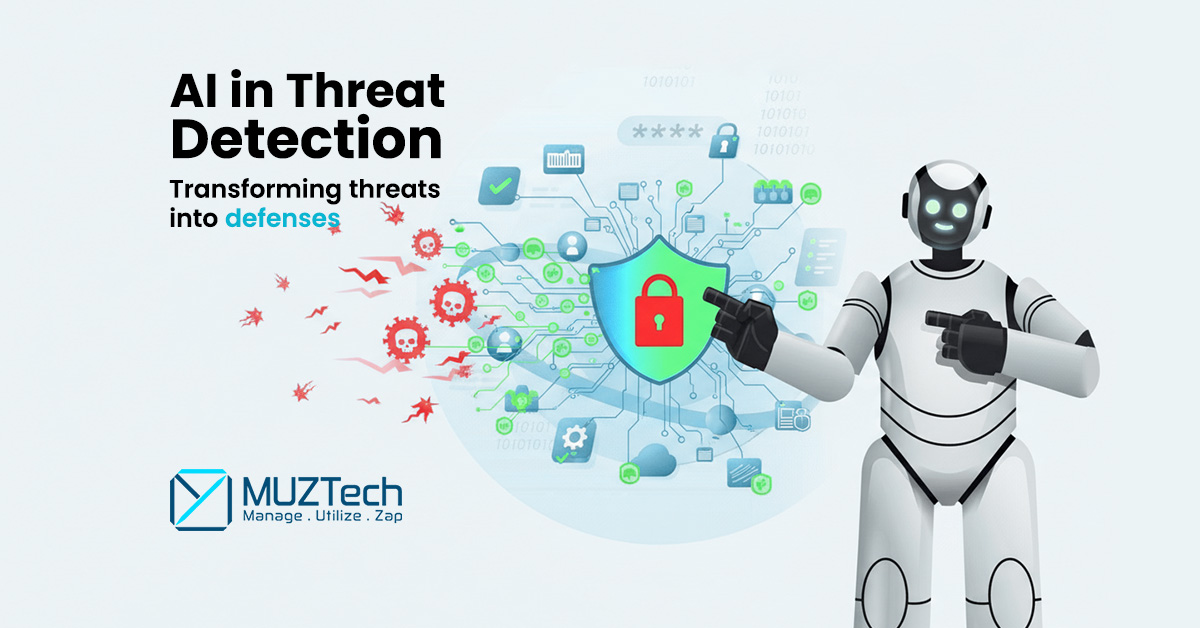
Transforming threats into defenses with AI in Threat detection
Artificial Intelligence (AI) technology has enhanced threat detection and vulnerability prioritization for almost 56% organizations during the last year.
With rising cybercrimes and sophisticated digital attacks, there is a need to strengthen organizational security infrastructure. The use of Artificial Intelligence to detect cyber threats has emerged as defensive technology.
According to 70% IT security experts, AI in threat detection ensures timely identification of threats that were previously hidden. Does a career as a Threat hunter excite you? Or are you already managing an organization’s cybersecurity team?
Regardless of your position, you can treat this blog as your guide for understanding Threat detection and response. We will also discuss how AI is a major security threat for the future. Moreover, you will get to see how AI in threat detection defends an organization’s security infrastructure. Its advantages, drawbacks, and best advice on choosing an AI model along with tips for IT managers.
Let’s start exploring how we can counter AI-based cyber threats with AI-driven security systems.
What is the purpose of threat detection in cybersecurity?
Threat detection and response (TDR) are specialized security processes used for the identification, analysis, and mitigation of cyber threats. Malicious activities affect an organization’s application, data repositories, networks, and devices.
With the help of TDR, such security weak spots are taken care of before any exploitation.
Threat detection and response deals with several security attacks, including but not limited to the following:
Ransomware and Malware
These are encryption-based cyber-attacks that disrupt the operations of a system and harm it. Moreover, these attacks are carried out for various purposes, like data exploitation or demanding ransoms.
There are many types of malicious cyber-attacks such as spyware, trojan, worms, adware and more.
Moreover, these cyber threats can be detected with techniques like heuristic analysis for sophisticated and advanced cyber threats. Meanwhile, security professionals use signature-based detection and analyze patterns to spot malicious activities within a system.
Advanced persistent threats (APTs)
APTs or advanced persistent threats are specialized attacks targeting government level networks and systems with extended periods of access. These attacks are mostly used for data theft or to tamper with the operational efficiency of an industry.
Cybersecurity professionals utilize advanced mitigation techniques like installing firewalls and patch systems. Moreover, large-scale organizations use multi-factor authentication (MFA) for advanced access control and data integrity.
Phishing scams
Phishing scams are the kind of cyber-attacks used with advanced social engineering to manipulate a user into sharing sensitive information. There are a number of phishing scams including spear phishing, voice phishing, email phishing, smishing, whaling, and more.
Insider Threats
Insider threats are the kind of cyber-attacks that are carried out with the help of malicious employees. They leak their user access for various reasons including personal gains, financial issues, or more.
Security engineers and organizations use various countering strategies such as:
Remote desktop control: This mitigation technique is used to prevent data theft and phishing attacks carried out by insiders.
User and Entity behavior analytics UEBA is used to analyze employee behaviors to instantly spot malicious or unusual activities in the network or system.
Zero-day Attack
Zero-day cyber-attacks or commonly known as zero-day exploits, are used by hackers to manipulate software vulnerabilities. They use this technique to target a huge number of systems before a security patch is released.
The best way to counter such attacks is patch management, vulnerability scanning, data validation and more.
Data Breaches
Data breach is a kind of cyber-attack that targets the sensitivity of personal information through unauthorized access. These types of criminal attacks result in worse situations such as data theft, exposure to dark web, or information loss.
What are the technologies used by security professionals for threat detection?
We’ve covered the significance of threat detection and response and how it deals with various cyber-attacks. Here’s a few TDR technologies used by security professionals:
Security Information and Event Management (SIEM)
The SIEM technology uses AI in threat detection to automate vulnerability and user behavior anomaly detection. This threat and detection response technology is used to mitigate cyber threats to maintain the seamless process of business operations.
Security Orchestration, Automation and Response (SOAR)
With the help of the SOAR technology, Security operation centers (SOC) analysts can automate threat detection and enhance response rate. SOC analysts can collaborate and make better decisions with the help of SOAR technology.
Identity Threat Detection and Response (ITDR)
The identity threat detection and response technology are used to analyze and detect vulnerabilities connected to user identities within an organization. According to IBM Threat intelligence statistics, almost 30% of network intrusions are the result of identity-based attacks. ITDR is a proactive security approach used to protect users.
Network Detection and Response (NDR)
Network detection and response technology use AI in threat detection and behavioral analysis to identify and respond to security vulnerabilities. The NDR technology is useful for real-time threat detection and threat hunting.
Endpoint Detection and Response (EDR)
Endpoint detection and response technology utilize AI in threat detection that automates real-time data analysis to ensure the protection of end users. EDR is essential for endpoint data collection, threat investigation, and mitigation along with incident response automation.
Extended Protection and Response (XDR)
Extended detection and response or XDR technology is used for the integration of security tools in the security architecture. This technology helps in ensuring the security of networks, applications, endpoints, data, and more. It is used as a SaaS product for threat hunting, real-time data analysis, and automated responses.
Data Loss Prevention (DLP)
DLP technology is used to ensure the safety of sensitive and personal data from exploitation and unauthorized access and exposure. As technology and cyber threats are advancing, the protection of organizational data is essential. DLP protects data from data leakage, data breach, and exfiltration.
Data Detection and Response (DDR)
Data detection and response technology are used to ensure data integrity regardless of the server it is stored on. DDR includes the monitoring and collection of data in cloud environments, on-premises, or multi-cloud environments. It is used to protect data from insider attacks, ransomware, and manage security compliance.
Why is Artificial Intelligence (AI) considered a threat to cybersecurity?
The way artificial intelligence has smoothly enhanced business operations to scale them; it has simultaneously been the biggest cybersecurity threat. Cyber criminals are also using generative AI technology for precise social engineering and advanced cyber-attacks.
According to statistics, around 60% of malicious actors invest in the technology of generative AI to carry out cyber-attacks. They use AI to generate emails, voice mails, SMS, and videos that sound almost original.
Here’s how cyber criminals are using the sophisticated AI technology for carrying out severe attacks:
Convincing Deepfake technology
Malicious actors use personal information of people to build voice clones with specialized deepfake technology. It is created with the help of artificial intelligence and is not limited to voice but creates pictures and videos. Hackers use this technology for personal and financial identity fraud.
AI-based Malware generation
Cyber criminals now use AI to generate malicious threats that are undetectable by antivirus software and firewalls. This malware penetrates the system or network to steal data or disrupt the flow of operations.
Automated Phishing scam
Hackers use artificial intelligence to generate massive emails that are identical in writing tone and style as the original user. Moreover, bad actors automate the process of sending phishing emails that make it difficult to ignore.
The impact of Generative AI in Cyber Crimes
We’ve discussed how cyber criminals use generative AI to target organizations, users, networks, and data. However, it leaves a bad impact on the organizations, such as:
- It can cause severe reputation damage, data loss, as well as breaks the client’s trust.
- Organizations face massive financial losses due to identity fraud and ransomware attacks.
- Cyber-attacks can cause severe damage to the operational efficiency of business, along with expensive systems or network recovery.
What type of AI models are used for Threat Detection?
Artificial intelligence has caused various security concerns for organizations. Meanwhile, AI in threat detection has made it easier for security professionals and organizations to maintain their security architectures.
Here’s a list of AI models used for threat detection by security teams:
Natural Language Processing (NLP)
Natural language processing models are an excellent use of AI in threat detection. These models identify phishing attacks by scanning and analyzing the text of emails or messages by understanding human language.
Deep Learning
AI in threat detection uses deep learning models to analyze and interpret complex patterns. These recognized patterns can be in the form of visual data or more and are analyzed for malicious activities.
Reinforcement Learning
This type of AI-driven threat detection works autonomously and identify cyber threats without any human participation.
Machine Learning (ML)
AI in threat detection utilizes machine learning (ML) models to analyze user behaviors, conduct predictive analytics, and signature-based detection.
Artificial Neural Networks (ANNs)
The artificial neural networks model is used for vast data analysis and interpretation to find vulnerabilities or unusual activity.
How is AI used in threat detection?
AI in threat detection has helped 43% organizations in enhancing their threat analysis. Here’s how AI in threat detection can be useful:
Effective Security incident investigation
AI in threat detection is used for analyzing the seriousness of security incidents and providing actionable insights for enhanced investigation. Moreover, incident prioritization helps save security resources.
Enhancing Incident Response time
The automation with the use of AI in threat detection has helped in analyzing real-time network activity. This helps the incident responders successfully mitigate attacks with fast incident responses.
Decreasing the rate of False positives
False positives are the kind of security alarms that surface due to errors and results in the wastage of security resources and time. AI in threat detection uses precise analysis along with pattern recognition to reduce false positives.
Detecting Zero-day attacks
AI in threat detection uses behavioral analysis and anomaly detection to detect zero-day vulnerabilities in software that went unnoticed by developers.
Major Advantages of using AI in threat detection
AI in threat detection has made the identification, prioritization, and mitigation of threats easier. Here’s a list of advantages observed by security teams for using AI:
Automated Data Analysis
Automated data analysis has made it easier for security teams to analyze cloud activity, endpoint security, network logs, and more.
Covers Lack of Skilled Professionals
There is still a lack of skilled cybersecurity professionals in the IT industry. AI in threat detection helps with the management of mundane security tasks so that security professionals can deal with mitigation. According to statistics, 50% of organizations use artificial intelligence to cover the lack of skilled professionals.
Works Faster than Humans
AI in threat detection effectively reduces dwell time so that the security professionals can mitigate the threat and respond effectively.
Smart Security for Sophisticated Attacks
Since cyber criminals also use artificial intelligence to plan and carry cyber-attacks, relying on manual security is useless. AI in threat detection works smartly to detect malicious activity that went unnoticed by firewalls.
What are the drawbacks of AI-driven threat detection?
Along with the benefits of using AI in threat detection, there are some drawbacks too, such as:
AI Model or Data Poisoning
Cyber criminals can cause data or model poisoning by manipulating the data used for training the AI model.
Data Privacy Issues
AI models use large sets of data and inputs to train itself. This led to the exposure of personal or confidential information, leading to exploitation.
Bias or Manipulated Outputs
The AI models interpret and analyze situations according to the data it is trained with. If the data contains discriminatory information or manipulated context, the model will use it.
Needs Human Intervention
AI threat detection is effective, but it is not entirely automated and demands human participation for complex issues.
How to choose an AI-based model for Threat detection?
Step-by-step procedure to choose an AI-driven threat detection model for your organization:
Define your security goals
What are your organizational security concerns? Identify and analyze the kind of cyber threats your organization deals with.
Integration with existing security system
To enhance the effectiveness of the model, integrate it within your existing security system such as SIEM, EDR, and more.
Choose a Hybrid model
It is better to choose a hybrid AI model that can carry our behavior analysis and anomaly detection.
Retrain the AI model
Training your model with an effective and indiscriminatory dataset enhances performance efficiency.
Incorporate Human participation
Never depend entirely on the AI model and ask your security team to verify and deeply investigate every alert.
Regularly test your AI model
It is effective to use penetration tests to investigate the strength and effectiveness of your AI-driven threat detection model.
How does AI in Threat detection resolve industry security concerns?
Here’s how AI in threat detection helps various industries in making accurate security decisions:
Healthcare sector
AI models help in detecting malicious actors and activities within cloud environments, EHR systems, and medical related devices.
Financial sector
AI helps the financial sector by identifying unusual activity and behavior to prevent financial loss and identity fraud.
National security
AI-driven threat detection helps security teams working on government level to identify and mitigate threats to critical infrastructure or communication networks.
Educational sector
AI in threat detection helps educational sectors in mitigating threats, securing endpoints and users from data or identity theft.
How can IT managers and security leaders benefit from AI-driven threat detection?
Security officers or IT managers can use the following procedure to avail the benefits of AI threat detection:
Incorporate AI-based Security systems
It is important to invest in effective tools and technologies to avoid cyber-attacks and detect threats before exploitation.
Invest in IT staff education
It is important to invest in cybersecurity consultation to address the employees regarding attacks like phishing, identity fraud, and more.
Ensure Zero-trust policy
Maintain strict user authentication policies before permitting access to ensure safety from unauthorized access.
Strategic Incident response planning
Focus on a proactive security approach rather than reactive. Having incident response plans for different cyber-attacks can be ideal to counter future attacks.
Changing the future of cybersecurity with AI in Threat Detection
Statistics reports that organizations who integrated AI for cybersecurity purposes witnessed around $1.76M decrease in security breach expenses.
AI in threat detection helps in automating the identification and prioritization of harmful cyber threats. Organizations can leverage this technology to reduce downtime, cut recovery costs, and fill skill or labor gaps.
Frequently Asked Questions
Q. What are the four types of threat intelligence?
Threat intelligence is the process of identifying, gathering, and analyzing information on diverse cyber threats. It is used by cybersecurity professionals to understand the attack type, technologies used, and to develop better defense techniques.
There are 4 types of threat intelligence used by threat hunters and engineers, such as:
- Operational Threat Intelligence: This type of threat intelligence spans between a period of one to six months. Threat hunters incorporate this type of threat intelligence to study the malicious attacks particular to their industry.
- Strategic Threat Intelligence: CISOs of an organization use this type of threat intelligence to strengthen the security posture. It is used to create security policies and define budget and infrastructure requirements.
- Tactical Threat Intelligence: It is used by SOC analysts to improve the threat-hunting techniques and incident response timing.
- Technical Threat Intelligence: This type of threat intelligence is used by researchers and analysts to build strategies for countering cyber threats and attacks. The purpose of this threat intelligence is to detect malware and find security vulnerabilities.
Q. How many types of AI models are there?
Artificial Intelligence (AI) models use, analyze, and train with huge datasets for producing effective outputs. The content produced by these models is the result of pattern recognition, data analytics, and predictive analysis.
Here are the types of AI models used for various purposes, including:
- Machine Learning Model (ML)
- Deep Learning
- Supervised Learning Model
- Unsupervised Learning Model
Q. How do security professionals detect cyber threats with AI?
AI in threat detection is an emerging technology that uses deep learning and ML technologies to spot cyber threats. It uses anomaly detection, behavioral analysis, and predictive analytics for the identification of threats.
Q. How can AI be used in crime detection?
Law enforcement officials and cybersecurity professionals work together to train AI models in detecting criminal activities. They used dark web intelligence to find hacker discussions, attack tools, and insider information.
Moreover, AI in threat detection helps in analyzing user behaviors on social platforms to detect criminal patterns.